Wednesday, 12 December 2018

Inclusive Webinar

"Inclusive Webinar Design and Delivery" #altc


A collection of links to come back to .....

https://www.assertion-evidence.com/


https://accessibility.umn.edu/start-small-start-now


https://github.com/UKHomeOffice/posters/tree/master/accessibility/dos-donts/posters_en-UK


https://toolkits.excellencegateway.org.uk/about-jisc-techdis-approach

https://www.jisc.ac.uk/guides?f[0]=field_project_topics%3A569

Microsoft Teams.

"Microsoft Teams for teachers and learners" #altc

https://docs.google.com/presentation/d/1YbgaeVFCS3pe3Ypoy78atVCSTmxQxJSjec1fe6kGfk0/edit#slide=id.g49dd3ada84_1_0

Informative demonstration of the features and functinality of Microsoft Teams.
It is a multi purpose space for team working, works within Office 365 requires Microsoft account.

Getting Sparky

"Getting sparky! The ultimate online learning activity toolkit!"

#altc #GettingSparky

https://blog.ucem.ac.uk/onlineeducation/posts/675

Diverse learners


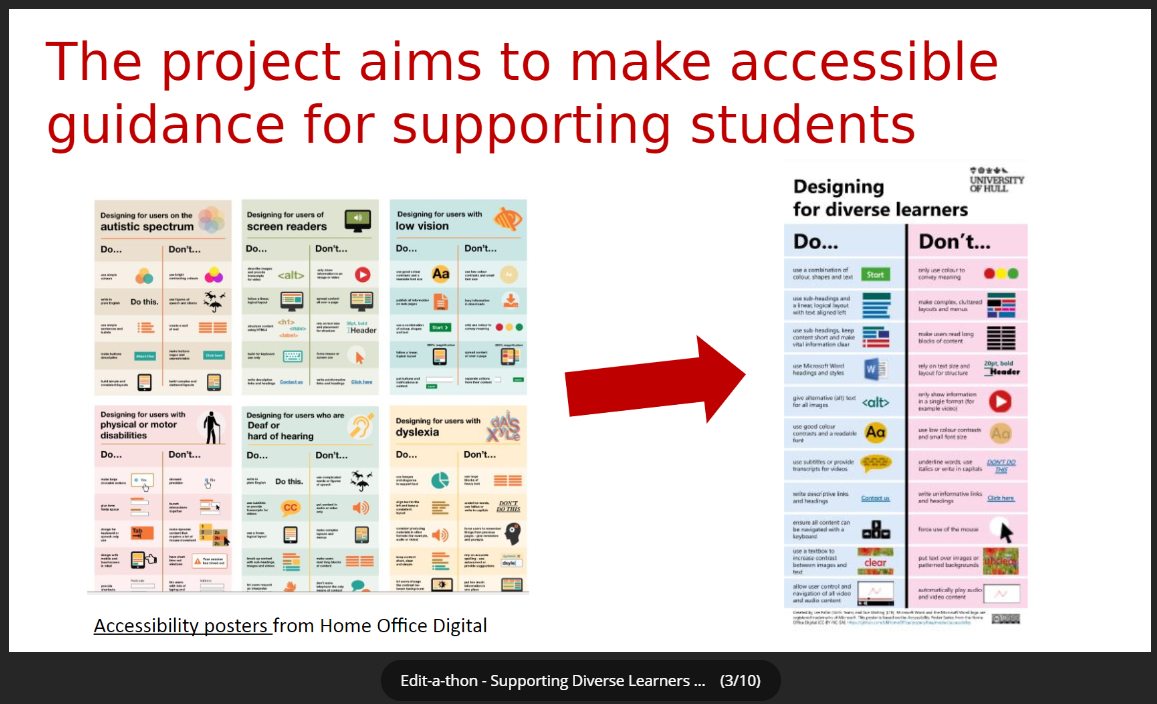
"Edit-a-thon: Supporting Diverse Learners" #altc


Example on the right is too complex, lots of information to try and understand.

Example on left is the developed example.

In this workshop we were invited to participate in 'live editing' within OneNote , this was a valuable activity, contributing to shaping the artefact and using One note.

Tuesday, 11 December 2018

Mirror mirror

"Mirror, Mirror: working towards a reflective digital practice" #altc

http://perceptions.lawriephipps.co.uk/

Screen capture Johari Window

My window - http://perceptions.lawriephipps.co.uk/add.php?add=true&usr=TEuBKDqUygowSFHjgFUfmNscEMPLr1rlGVWqymk6

Further resources: http://lawriephipps.co.uk/?page_id=8916

OER Treasure hunt

"Where are the OERs? A treasure hunt." #altc #treasurehunt
https://altc.alt.ac.uk/online2018/sessions/where-are-the-oers-a-treasure-hunt-180/

Story telling

"The future of Ed Tech – Storytelling workshop" #altc

Screen capture story telling

Keith says "Out of fear comes great creativity" B-)

Fruitful interactions

"Encouraging fruitful interactions in an online module" #altc

https://www.slideshare.net/secret/HFhLm27oaQV2QL

Screen capture fruitful interactions

Blended Learning Essentials

"Blended Learning Essentials Showcase" #altc

futurelearn.com/programs/blended-learning-essentials

Screen capture FutureLearn Blended Learning Essentials

ABC methodology

"Developing an online course: how to get started" #altc
Mari-Cruz Garcia
Screen capture ABC methodology

Nearpod or ?

"Nearpod in Higher Education - a pilot (Anne Hole and Kitty Horne)" #altc

https://nearpod.com/ variability of usage during the pilot. Some used https://en-gb.padlet.com/  or https://www.polleverywhere.com/ https://pollev.com/ instead.

Concerns regarding assessibility.
Accessibility regulations 
https://www.gov.uk/guidance/accessibility-requirements-for-public-sector-websites-and-apps
http://www.legislation.gov.uk/uksi/2018/852/contents/made
http://www.legislation.gov.uk/uksi/2018/952/made
https://gds.blog.gov.uk/2018/09/24/how-were-helping-public-sector-websites-meet-accessibility-requirements/

Equity unbound


"Experience Equity Unbound" #unboundeq #altc
http://unboundeq.creativitycourse.org/about/

Screen capture from Equity Unbound


Note to self: add alt tags to the images I have shared today!


Whatever you're developing or delivering remember these five golden rules to making Alt text work for your site visitors:

Rule 1: Every <img> must have an alt= attribute
Rule 2: Describe the information, not the picture
Rule 3: Active images require descriptive alt text.
Rule 4: Images that contain information require descriptive alt text.
Rule 5: Decorative images should have empty alt text.
https://www.abilitynet.org.uk/blog/five-golden-rules-compliant-alt-text


Screen capture from Equity Unbound
Opportunity to contribute...

Teaching as a public activity


"Teaching as a public, not private, activity." #altc

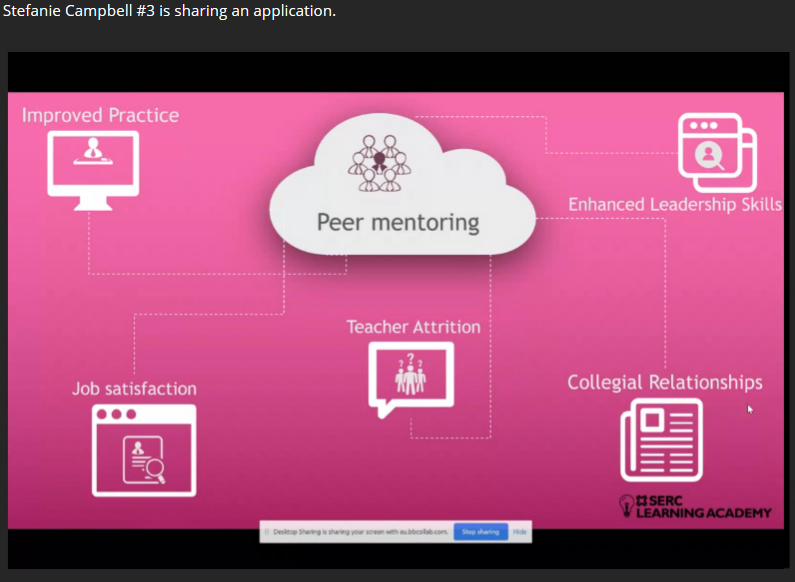
Screen capture from Stefanie Campbell presentation


Using technologies when teaching - "If we can stand in a room and teach with confidence, our students will have confidence in our teaching" Stefanie Campbell.
Screen capture from Stefanie Campbell presentation


#OpenClassroomWeek
https://altc.alt.ac.uk/online2018/sessions/teaching-as-a-public-not-private-activity-165/
Screen capture from Stefanie Campbell presentation

Enabling academic staff ... using active learning technologies

"Enabling academic staff to engage with disruptive pedagogies using active learning technologies" #altc


Created using Microsoft Sway
Another neat looking interface to explore.....
Note to self: explore at work, do we have a licence for this?

Jammin #altc

#altc "Creating a story about space and place"
This looks so cool
Jamboard image
https://jamboard.google.com/

https://jamboard.google.com/d/1WuNhynsmdmx8Pn9yRLBkmOtY6tRQ9EHaUSxvrdC78-k/viewer

New day! New connections! New Ideas! #altc

Attending the ALT’s Online Winter Conference! #altc 2018

#alt25years New day! New connections! New Ideas!
Postcard image visualthinkery

Thursday, 9 August 2018

Forgive me it has been so long since my last post...


image of blank paper, notebook and coffee cup
Blank paper
-  image source pixabay.com/
I recently attended a staff development workshop to learn how to develop 'Infographics'. 

Please read about my experience in this post - https://writingpad.our.dmu.ac.uk/2018/08/09/evolution-of-an-infographic/

If you have not tried it then I encourage you to do so, despite my initial apprehension it was good fun, I am proud and pleased with the final result.


Tuesday, 27 May 2014

Understanding Learners and Learning (Wk2)

Deep, surface, strategic?

Activity:
Your task is to think about the general idea of ‘approaches to learning’ in relation to on-line learning. Questions for consideration are:

Have you seen any evidence of these different approaches in on-line contexts, e.g. in technology-enhanced courses you teach? How did these differences manifest themselves in terms of on-line learning behaviour?

Source: Marton, F., Hounsell, D. and Entwistle, N., (eds.) The Experience of Learning: Implications for teaching and studying in higher education. 3rd (Internet) edition. Edinburgh: University of Edinburgh. http://www.ed.ac.uk/schools-departments/institute-academic-development/learning-teaching/staff/advice/researching/publications/experience-of-learning

===================


Hmmmm ... the course I am teaching on currently is a course for professional registration, most of the delivery is face to face.
The on-line component provided by the teaching team are primarily supplementary activities and resources. In the flavour of a 'flipped classroom', I have developed a series of on-line activities where students explore the subject in detail at their own pace during individual study time before attending a seminar group where we can discuss and work with the material from their on-line activities.
My reflections on student engagement -  A mixture of approaches to learning. I have learners who appear keen to learn and appear comfortable in their on-line engagement, seeking out on-line activities and prompting their provision when they want a greater challenge.  There are those who are less engaged and appear to do the bare minimum, reliant on their peers having done the preparatory work.
There are also students who have not logged into the module/course shell despite being many months through the module/course?!

Given the 'optional' status of these on-line learning activities, and the competing demands on students time through 'mandatory' and 'required' components of the course I am not entirely surprised by the low engagement in the activities provided. We have had students complain if the 'lecture' time is reduced, identifying attendance as the most important measure rather than engagement or product output from participating in the lecture activities.
In the world league tables and comparing courses to shop around, students need data to measure. Number of hours in 'lectures' is identifiable and measurable! So shouldn't we also specify the hours of on-line teaching and learning so this can be considered openly?

To increase engagement the messages behind the teaching and learning activities needs to change.

"The framework of institution, department and courses, affects students’ perceptions of reading, listening to lectures, writing essays and solving problems. Students do not, for example, simply read an article. They read it for a purpose connected with a course of study and in response to the requirements of those who teach the course" (Ramsden 2005: 198).

My thoughts and opinions*.... institutionally, programme and at course level I/we need to include the on-line teaching and learning as a component of the course/module and not an optional or hidden extra. I/we need to build in the students anticipation to engage in richness of learning in a variety of media and see it as part of the course. There needs to be value in this mode of learning and teaching which is carried across all levels of the institution. I/we need to provide for the range of 'learning styles' in anticipation of the diversity of student learning needs and expectations.

I would live to know your thoughts and opinions? How are you valuing these mode of teaching and learning within your organisation?

Final words...

"This indirect connection between how lecturers teach and how their students learn has a crucial implication for how we should try to develop teachers’competence in higher education. It suggests that staff development programmes should aim not only to improve teaching skills, but also to increase lecturers’ awareness of their students’ experiences of learning. In the last analysis, these two facets of staff development are inseparable. Good teachers have to be aware of their students’ needs and purposes, sensitive to their students’ perceptions of the course—and adapt their teaching and assessment methods accordingly. Our attention should be on the quality of learning, not simply on how to improve the techniques of teaching.
This emphasis on the effects of teaching is, however, not intended to remove responsibility entirely from the student. On the contrary, the decision to use different approaches to studying is largely in the student’s own hands. Different students want different things from higher education and respond differently to similarly perceived conditions. Some cope better than others with adverse assessment and teaching conditions, and only part of the variation in the quality of learning is explained by contexual influences. But it would be a mistake to try to force a dichotomy between student characteristics and context in understanding how students learn: If we accept that individual students’ learning skills will affect which approaches they use, and whether they achieve their goals, we should also recognise that learning skills are themselves influenced by previous experiences of learning contexts" (Ramsden 2005:216).

* These are my personal thoughts and opinions.

Ramsden. P. (2005) 'The Context of Learning in Academic Departments'. In: Marton, F., Hounsell, D. and Entwistle, N., (eds.) The Experience of Learning: Implications for teaching and studying in higher education. 3rd (Internet) edition. Edinburgh: University of Edinburgh, Centre for Teaching, Learning and Assessment. pp. 198 - 216.

Week 1 activities

Webinar 0 and 1 ..... stimulating the little grey cells......

Really great having the live webinars cast via #YouTube.

I decided to follow up some of the links shared so here they are.

Digital literacy, what they are and how to attain them...
http://www.bath.ac.uk/learningandteaching/courses-development/current-projects/pride-project.html

The Eight elements of digital literacy are key to this project -http://digilitpride.wordpress.com/2012/10/01/making-sense-of-the-8-elements-of-digital-literacy/

3E Framework
http://staff.napier.ac.uk/services/vice-principal-academic/academic/TEL/TechBenchmark/Pages/Introduction.aspx

A model of ELT at DMU
https://celt.our.dmu.ac.uk/support-using-technology/elt-key-documentation/a-model-of-elt-at-dmu/

Evaluating digital services: a Visitors and Residents approach
http://www.jiscinfonet.ac.uk/infokits/evaluating-services/


A further area of digital literacy is 'digital health literacy', as 'patients' and 'health care professionals' we are increasingly reliant on the www for accessing and providing health information, booking health appointments and ordering prescriptions. We are increasingly exposed to innovations in 'ehealth', 'tele health and care', recent live cast of surgery via GoogleGlass . Many of these are aimed at improving health or the opportunity to manage our own health more independently.

But when do our health providers check our digital health literacy? or our ability to use the technology or our confidence and trust in the technology?

I recently attended a conference day for DISCOVER Skills For Carers an exciting initiative to equip carers with digital literacy for health.

Visit http://www.discover4carers.eu/      http://moodle.discover4carers.eu/


Research and innovation in this area is increasing globally, overcoming geographical boundaries and widening access to health information and care.


Links:

W.H.O. Health literacy and health behaviour - http://www.who.int/healthpromotion/conferences/7gchp/track2/en/


Lurking with intent?

This season I shall be mostly........ Lurking ;-)


Still getting to know my Chromebook and discovering its limitation and opportunities for liberation.

Inclusive Webinar

"Inclusive Webinar Design and Delivery" #altc A collection of links to come back to ..... https://www.assertion-evidence.com/ h...